
Topping DX9 Discrete

€1,299.00*
Not in stock
Fully balanced desktop DAC and amplifier
- Proprietary 16-element PSRM 1-bit DAC architecture
- Six-channel discrete NFCA headphone amplifier
- Ten-band high-precision PEQ with software control
- Up to 7,080 mW × 2 output power at 32 Ω
- Equipped with Qualcomm’s flagship Bluetooth chipset, the QCC5125
TOPPING DX9 DISCRETE – balanced discrete R2R DAC headphone amplifier
The Topping DX9 Discrete is an R2R DAC/headphone amplifier with even better performance than its predecessor, the DX9, which was based on AKM technology. The DX9 Discrete is based on a balanced PSRM circuit with 16 elements per channel combined with R2R resistor networks, as well as an AK4118 optical receiver chip and an XMOS XU -316 USB interface, enabling support for high-resolution sampling rates up to PCM 32-bit 768 kHz and DSD512.
The circuit is complemented by an Altera MAX II CPLD, a high-precision clock generator, a relay-based volume control, and a 6-channel NFCA amplifier circuit for unmatched performance and power.
The DX9 Discrete delivers up to 2 × 7080 mW to a 32-ohm load via its headphone outputs.
It also features a QCC5125 Bluetooth receiver chip that supports the aptX, aptX Adaptive, aptX HD, and LDAC codecs.
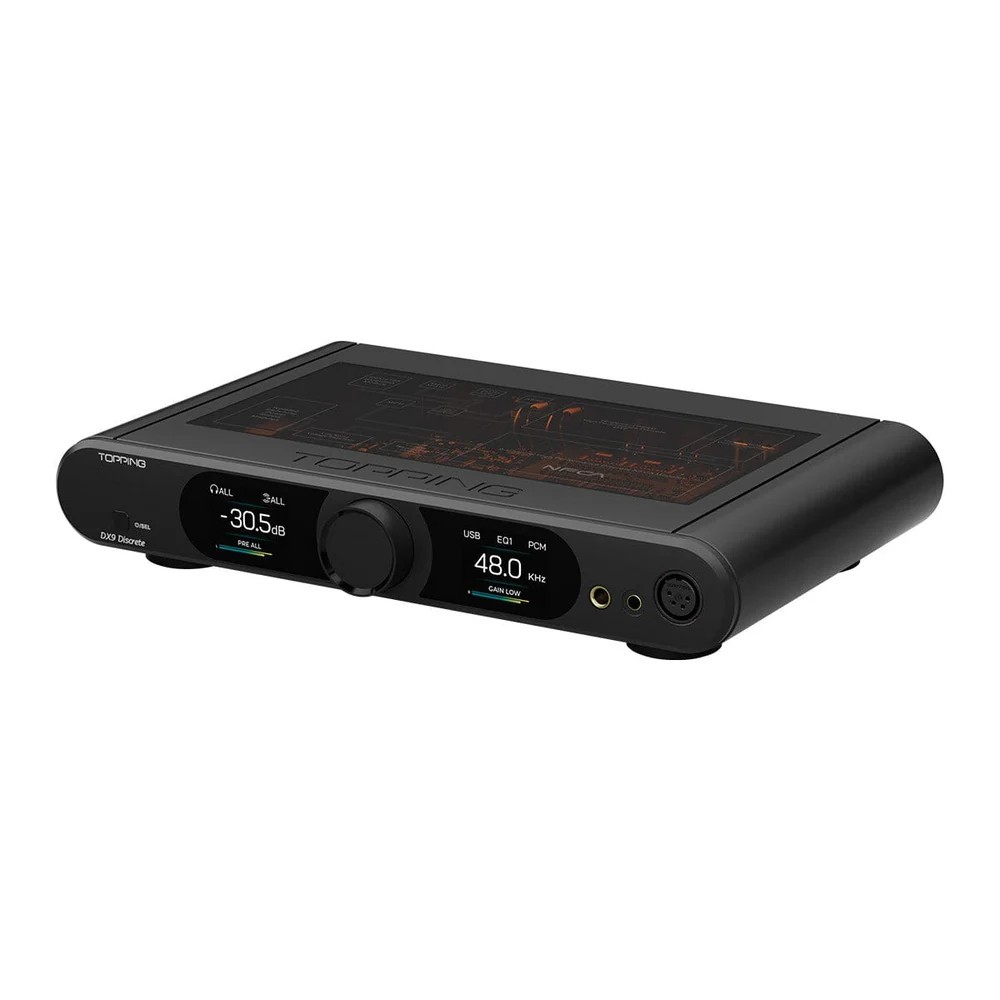
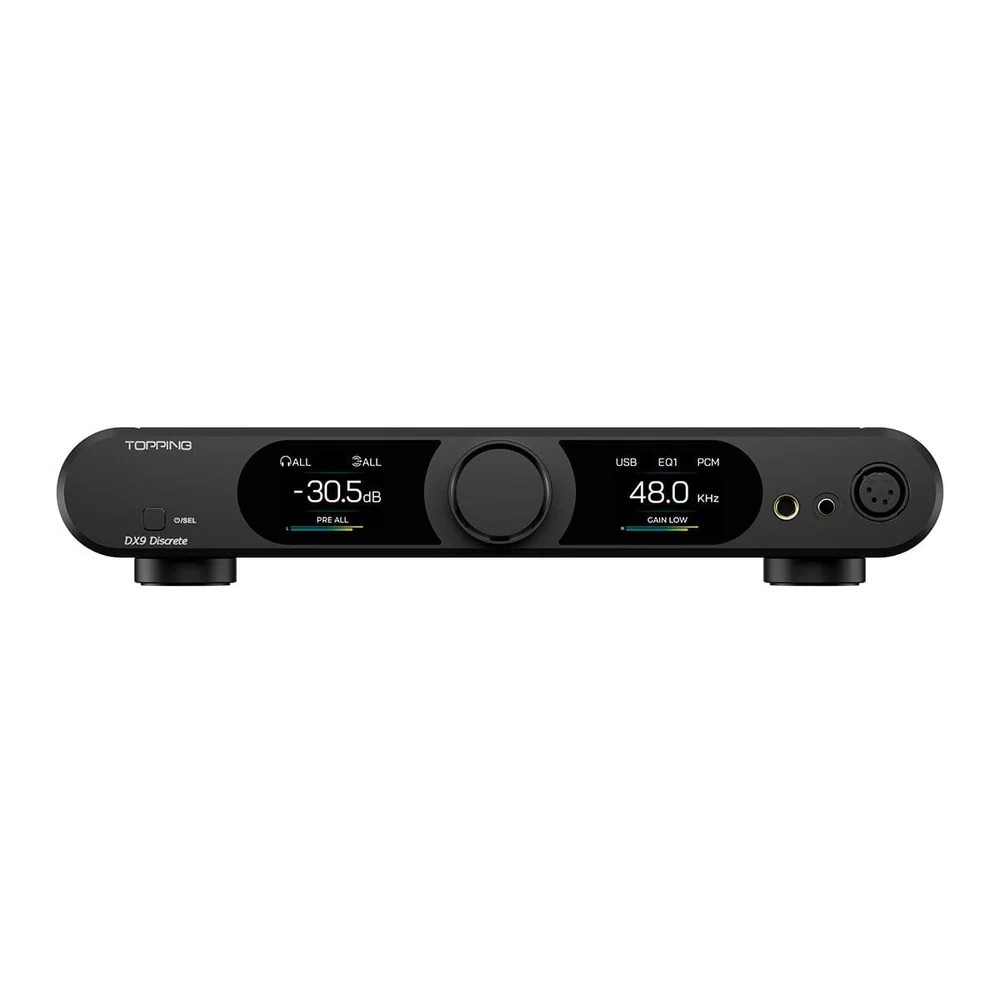
Visually, it retains the design of its predecessor, with a curved chassis featuring a transparent cover and two-tone displays running the Aurora UI.
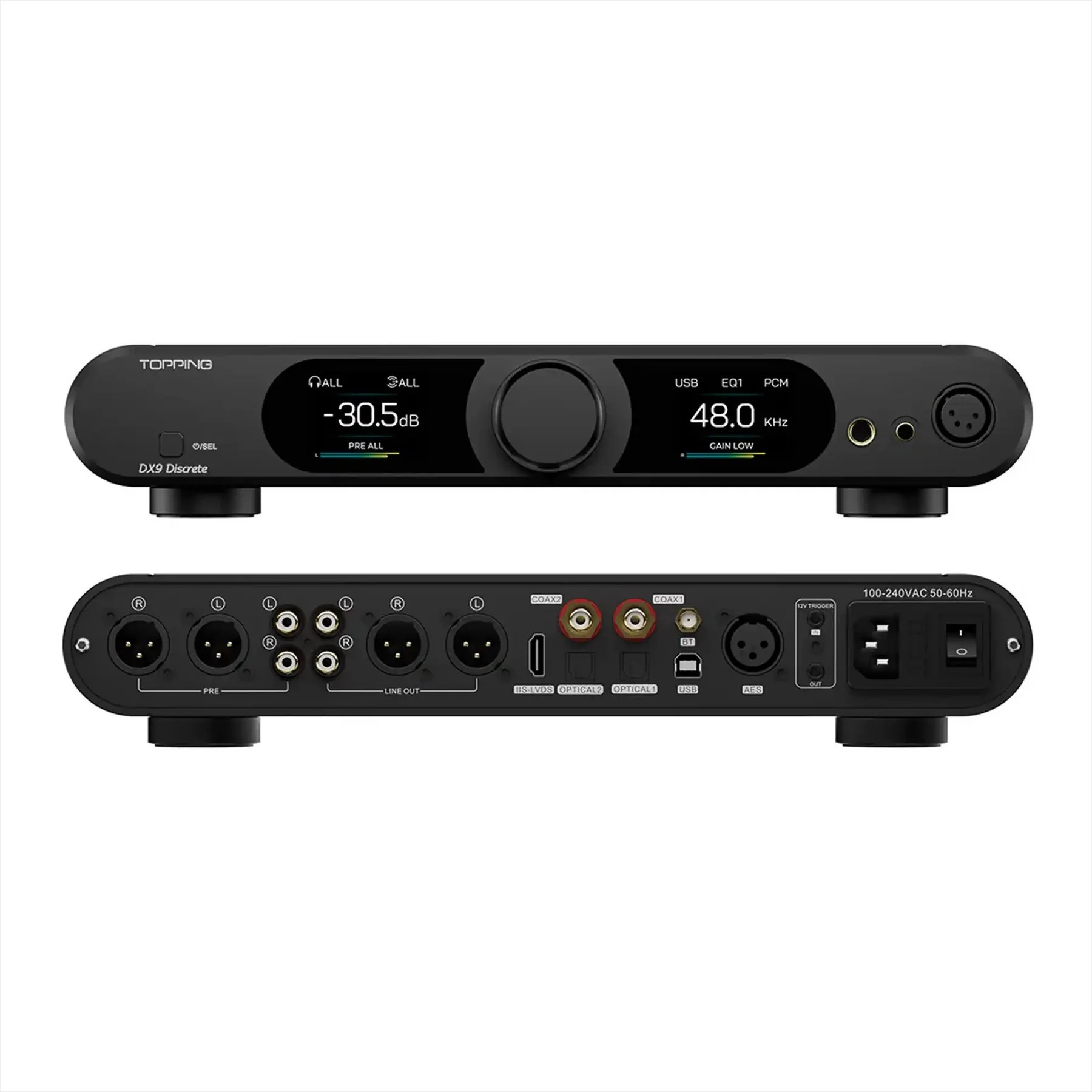
In terms of connectivity, it is in no way inferior, offering a comprehensive selection of digital inputs, a set of RCA/XLR line outputs, and a set of RCA/XLR preamp outputs.
Topping DX9 Discrete: PSMR + R2R Hybrid DAC
The Topping DX9 Discrete DAC features the brand’s proprietary 1-bit PSRM technology combined with R2R resistor networks for high-precision decoding. Topping’s PSRM technology enables the R2R to process a 1-bit signal, resulting in even greater stability, lower noise, and very high dynamic range. Thanks to this hybrid R2R and 1-bit modulation technology, the DX9 Discrete offers a signal-to-noise ratio of 131 dB.
The DAC Architecture of the TOPPING DX9 DISCRETE
Audiophile Components
The entire structure of the DX9 Discrete consists of high-quality, audiophile components.
It features a USB XMOS XU316 interface and an optical AK4118 interface, coupled with an Altera MAX II CPLD, enabling support for high-resolution sampling rates up to PCM 32-bit 768 kHz and DSD512 while simultaneously eliminating jitter to achieve a value of -160 dB.
Bluetooth aptX LDAC
Thanks to a Qualcomm QCC5125 chip, the DX9 Discrete features Bluetooth 5.1 functionality and supports the SBC, AAC, aptX, aptX HD, aptX Adaptive, and LDAC codecs for reliable and stable wireless transmission.
Refined Aesthetics and Ergonomics
The rounded curves of the DX9 Discrete give it a unique aesthetic. Combined with two color displays and the Aurora UI, the user experience is exceptional. To top it off, a transparent cover on the top of the device offers a view of the internal circuitry.
Say Goodbye to Jitter
A CPLD, combined with a precision clock, optimizes the digital signal and performs two-stage amplification. This ensures deep jitter suppression and reduces artifacts to virtually zero, resulting in clearer, more defined vocals and instruments. The AK4118 receiver processes coaxial, optical, and AES inputs and delivers an ultra-clear digital signal with a jitter of just 50 ps RMS, supporting up to 768 kHz PCM and DSD512. In a standard jitter test, the DX9 Discrete achieves jitter values of up to -160 dB.
Proprietary I/V Conversion
Designed for ultimate sound and optimized for PSRM, the I/V conversion combines low-distortion operational amplifiers with low-noise discrete components to process signals with precision. This fully unleashes the dynamic potential of the music, delivering rich dynamics and an immersive listening experience.
Fully balanced hybrid relay volume control
The hybrid relay resistor network enables ultra-precise volume control, eliminates channel imbalance at low volumes on balanced outputs, and ensures pinpoint vocal imaging. The combination of relay circuitry and digital volume control results in lower distortion and superior noise immunity. The result is music with greater purity, accuracy, and realism.
Headphone Crossfeed
A convolution-based crossfeed precisely models HRTFs and room acoustics, resulting in significantly improved imaging accuracy and spatial depth. The result is a more natural soundstage with reduced in-head localization and the near-ear effect typical of traditional headphone listening. Careful sound calibration ensures that the system preserves both sonic integrity and realistic spatial presence, thus avoiding the artificiality that can result from simply flattening the frequency response. For those who prefer a smoother, speaker-like listening experience, an improved, BS2B-based simplified mode is also available, offering relaxed, natural playback without relying on room reflections.
Ten-band high-precision PEQ
Topping’s new PEQ system offers ten fully customizable frequency bands based on a newly developed algorithm and intuitive desktop software. The frequency, gain, and bandwidth of each band can be precisely fine-tuned to match your ideal sound profile. The software supports the import of both target and raw frequency response curves, enabling precise curve compensation as well as effortless profile management with multiple presets for quick switching. Each output supports an independent PEQ configuration, allowing both headphones and speakers to be tuned to their optimal sound balance.
Six-channel discrete NFCA amplifier
Equipped with top-of-the-line discrete NFCA circuitry, the single-ended and balanced headphone amplifier circuits are completely independent of one another, preserving the characteristic low-distortion performance.
Actual noise levels* reach < 0.5 uVrms at G=L HP BAL OUT and < 1.1 uVrms at G=L HP SE OUT, while delivering 7080 mW × 2 at 32 kHz (THD+N < 1%)—ensuring that every headphone can reach its full potential.
Third-generation XMOS XU-316
At the heart of the DX9 Discrete is a high-end 16-core XMOS XU-316 processor, enabling ultra-high-resolution audio decoding with up to 768 kHz PCM and DSD512 for true high-fidelity, lossless playback. A custom-designed Thesycon USB driver ensures optimal performance on Windows systems, while plug-and-play compatibility makes setup on other platforms effortless.
Technical Specifications
Product Type: DAC/Headphone Amplifier
Inputs:
1x USB-B
2x Coaxial
2x Toslink (optical)
1x AES/EBU
1x I2S via HDMI
Bluetooth
Outputs:
1x balanced XLR stereo line output
1x unbalanced RCA stereo line output
1x balanced XLR stereo preamp output
1x unbalanced RCA stereo preamp output
1x unbalanced 6.35-mm headphone output
1x balanced 4.4 mm headphone output
1x balanced 4-pin XLR headphone output
DAC: 1-bit PSRM circuit + R2R
Optical interface: AK4118
USB interface: XMOS XU316
Supported sample rates: PCM up to 32-bit 768 kHz, DSD up to DSD512
Bluetooth-compatible codecs: SBC, AAC, aptX, aptX HD, aptX Adaptive, LDAC
12 V trigger supported: yes
DX9 Discrete DAC (Line output / USB source at 96 kHz)
THD+N at 1 kHz (A-weighted): RCA < 0.00007%, XLR < 0.00006%
THD at 20–20 kHz, 90 kBw: RCA < 0.0004%, XLR < 0.0003%
SNR at 1 kHz (A-weighted): RCA 128 dB, XLR 131 dB
Dynamic range: RCA 128 dB, XLR 131 dB
Frequency response: RCA 20 Hz–20 kHz (+/-0.6 dB) 20 Hz–40 kHz (+/-2.0 dB), XLR 20 Hz–20 kHz (+/-0.6 dB) 20 Hz–40 kHz (+/-2.0 dB)
Output level: RCA 2.5 V rms at 0 dBFS, XLR 5.2 V rms at 0 dBFS
Noise (A-weighted): RCA < 1.1 µV rms, XLR < 1.6 µV rms
Channel crosstalk: RCA -125 dB at 1 kHz, XLR -136 dB at 1 kHz
Channel balance: RCA 0.3 dB, XLR 0.3 dB
Output impedance: RCA 0.3 dB, XLR 0.3 dB
Supported sample rates: RCA 50 ohms, XLR 100 ohms
DX9 Preamplifier (USB source at 96 kHz)
THD+N at 1 kHz (A-weighted): RCA < 0.00007%, XLR < 0.00007%
THD at 20–20 kHz, 45 kBw: RCA < 0.0004%, XLR < 0.0003%
SNR at maximum output power 1 kHz (A-weighted): RCA 130 dB at 1 kHz, XLR 131 dB at 1 kHz
Dynamic range: RCA 130 dB at 1 kHz, XLR 131 dB at 1 kHz
Frequency response: RCA 20 Hz–20 kHz (+/-0.6 dB) / 20 Hz–40 kHz (+/-2.0 dB), XLR 20 Hz–20 kHz (+/-0.6 dB) / 20 Hz–40 kHz (+/-2.0 dB)
Output level: RCA: 15 Vpp at G=L / 24 Vpp at G=H, XLR: 15 Vpp at G=L / 48 Vpp at G=H
Measured noise level AP (A-weighted): RCA < 1.7 μVrms at G=L < 2.0 μVrms at G=H, XLR < 0.8 μVrms at G=L < 2.1 μVrms at G=H
Effective noise level (A-weighted): RCA < 1.1 µVrms at G=L < 1.4 µVrms at G=H, XLR < 0.5 µVrms at G=L < 2.1 µVrms at G=H
Channel crosstalk: RCA -113 dB at 1 kHz, XLR -135 dB at 1 kHz
Gain: RCA G=L 14.4 dB (Vrms/FS) / G=H 20.1 dB (Vrms/FS), XLR G=L 14.4 dB (Vrms/FS) / G=H 26.5 dB (Vrms/FS)
Channel balance: RCA 0.3 dB, XLR 0.3 dB
Output impedance: RCA 50 ohms, XLR 100 ohms
DX9 Headphone Amplifier (USB source at 96 kHz)
THD+N at 1 kHz (A-weighted): Single-ended output: < 0.00007% at 550 mW (32 ohms) / < 0.00007% at 60 mW (300 ohms)
Balanced output: < 0.00007% at 550 mW (32 ohms) / < 0.00007% at 60 mW (300 ohms)
THD at 20–20 kHz, 45 kBw: Single-ended output: < 0.00050% at 550 mW (32 Ω) / < 0.00050% at 60 mW (300 Ω)
Balanced output: < 0.00050% at 550 mW (32 Ω) / < 0.00030% at 60 mW (300 Ω)
Signal-to-noise ratio at maximum output power 1 kHz (A-weighted): Single-ended output 130 dB at 1 kHz, balanced output 131 dB at 1 kHz
Dynamic range: Single-ended output 130 dB at 1 kHz, balanced output 131 dB at 1 kHz -
Frequency response: Single-ended output 20 Hz–20 kHz (+/-0.6 dB) / 20 Hz–40 kHz (+/-2.0 dB), balanced output 20 Hz–20 kHz (+/-0.6 dB) / 20 Hz–40 kHz (+/-2.0 dB)
Output level: Single-ended output 15 Vpp at G=L / 24 Vpp at G=H, balanced output 15 Vpp at G=L / 48 Vpp at G=H
Measured noise level AP (A-weighted): Single-ended output < 1.3 uVrms at G=L < 1.6 uVrms at G=H, balanced output < 0.8 uVrms at G=L < 2.4 uVrms at G=H
Effective noise level (A-weighted): Single-ended output < 1.1 µVrms at G=L < 1.4 µVrms at G=H, balanced output < 0.5 µVrms at G=L < 2.1 µVrms at G=H
Channel crosstalk: Single-ended output -130 dB at 1 kHz, balanced output -133 dB at 1 kHz
Gain: Single-ended output G=L 12.5 dB (Vrms/FS) / G=H 18.5 dB (Vrms/FS), balanced output G=L 12.5 dB (Vrms/FS) / G=H 24.5 dB (Vrms/FS)
Channel balance: Single-ended output 0.3 dB, balanced output 0.3 dB
Output impedance: Single-ended output < 0.1 ohms, balanced output < 0.1 ohms
Output power:
Unbalanced output: 3300 mW x 2 at 16 ohms, THD+N < 1% 2120 mW x 2 at 32 ohms, THD+N < 1% 1190 mW x 2 at 64 ohms, THD+N < 1% 270 mW x 2 at 300 ohms, THD+N < 1%
Balanced output: 10,000 mW x 2 at 16 ohms, THD+N < 1% 7,080 mW x 2 at 32 ohms, THD+N < 1% 4,250 mW x 2 at 64 ohms, THD+N < 1% 1060 mW x2 at 300 ohms, THD+N < 1% 540 mW x2 at 600 ohms THD+N < 1%
Load impedance: Single-ended output > 8 ohms, balanced output > 8 ohms
General
Power supply: 100–240 VAC, 50–60 Hz
Dimensions: 34 x 23 x 6 cm
Weight: 2.75 kg
Color: Black, Silver
Package Contents
1x Topping DX9 Discrete
1x Remote Control
1x USB Cable
1x Bluetooth Antenna
1x 3.5 mm to 6.35 mm Jack Adapter
1x Power Cord